


Algeria-Mali Rapprochement: A Search for a New Balance in the Sahel
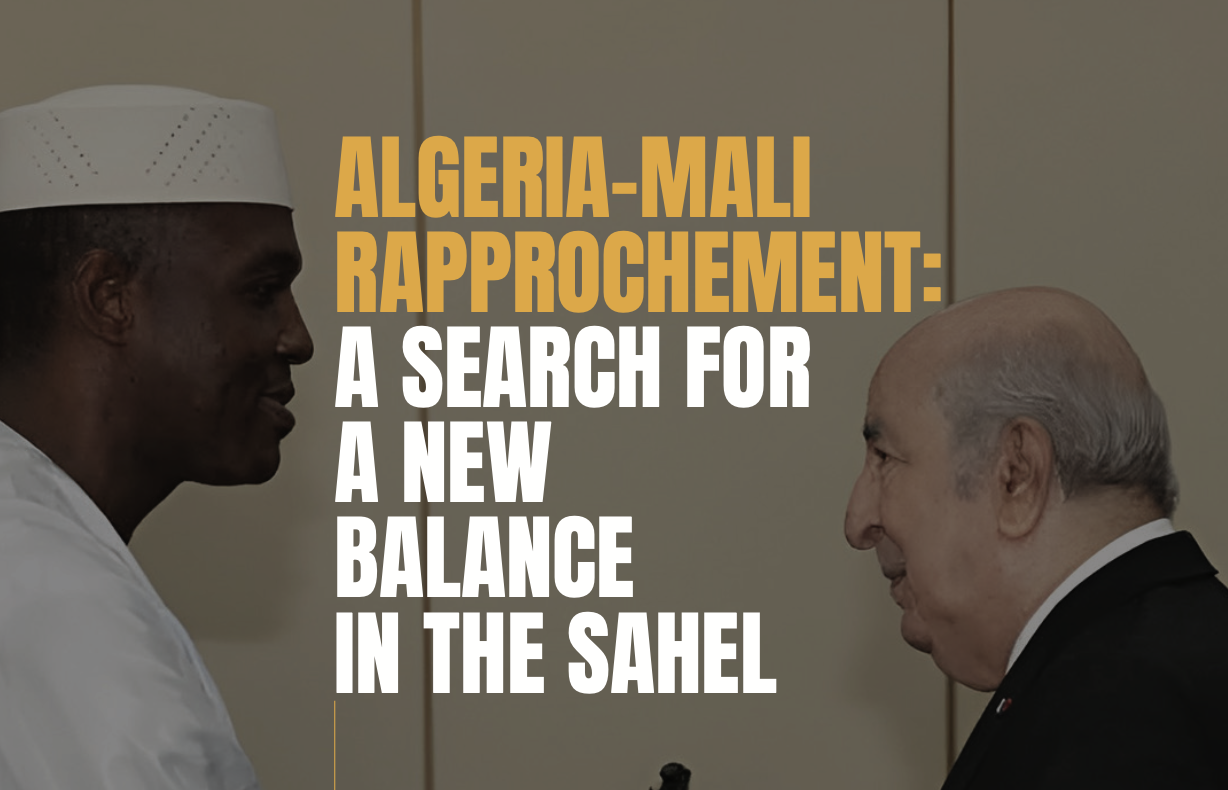
ALGERIA-MALI RAPPROCHEMENT: A SEARCH FOR A NEW BALANCE IN THE SAHEL
Executive Summary
On 24 August 2026, Malian Prime Minister Abdoulaye Maïga’s visit to Algeria and meeting with President Abdelmadjid Tebboune marked the normalization of relations after roughly 15 months of diplomatic tensions. However, the rapprochement should not be interpreted as a full reconciliation or a return to the Algeria-led mediation framework of the past. Rather, it reflects a pragmatic and conditional repositioning driven primarily by deteriorating security conditions in northern Mali and Algeria’s efforts to recover influence in an increasingly competitive Sahel. For Algeria, the normalization provides an opportunity to restore border-security and intelligence channels, limit the spillover of instability from northern Mali, and regain diplomatic relevance without entering into direct military competition with Russia or other regional actors. For Mali, Algeria offers an additional security and diplomatic partner while allowing Bamako to preserve its partnerships with Russia and Türkiye and its broader multi-alignment strategy. Neither side has, however, addressed the fundamental disagreements surrounding the 2015 peace agreement, armed groups in northern Mali, or Algeria’s previous mediation role. The rapprochement is also taking place amid Morocco’s expanding influence in the Sahel and Mali’s shift toward Rabat on the Western Sahara issue. This indicates that Bamako is increasingly treating Algeria, Morocco, Russia and Türkiye as alternative sources of diplomatic, security and economic support rather than accepting a single dominant regional patron. Algeria’s return to engagement therefore reflects not only security concerns but also an attempt to counterbalance Morocco’s growing regional presence. The durability of the rapprochement remains uncertain. Western Sahara, the possibility of renewed border incidents, the absence of a concrete bilateral mechanism and Algeria’s ability to influence Russia’s position on Mali remain unresolved. Accordingly, the current arrangement is best understood as a fragile and conditional repositioning rather than a strategic realignment. Both countries appear to be pursuing the least costly option available to protect their respective interests while avoiding commitments that could constrain their broader regional strategies.
Related Intelligence
Daily Brief
Get the daily intelligence summary delivered to your inbox every morning.