


The KAAN Program and the Possibility of a Strategic Defense Partnership with Saudi Arabia
Executive Summary
The KAAN fifth-generation fighter program represents a strategic effort by Turkey to achieve long-term defense autonomy through advanced airpower, while simultaneously reshaping its defense-industrial partnerships. Potential participation by Saudi Arabia would move the program beyond a traditional export model toward a risk-sharing, co-development framework that could improve financial sustainability, production scale, and technological resilience. For Turkey, Saudi involvement offers cost sharing, higher production volumes, and greater industrial continuity; for Saudi Arabia, it provides early-stage influence over a next-generation platform, opportunities for technology transfer, and alignment with Vision 2030 localization goals. While challenges remain, particularly in engine development, export controls, and program timelines, a KAAN–Saudi partnership could gradually reduce single-source dependency, expand strategic autonomy for both countries, and contribute to the emergence of a more diversified defense-industrial ecosystem in the Middle East.
Introduction: The Transformation of Next-Generation Defense Partnerships
The ability to develop a fifth-generation fighter aircraft is widely seen not merely as a sign of advanced engineering, but as the product of long-term strategic planning, sustained investment, and political autonomy in the defense sector. Low observability and sensor fusion distinguish these platforms from fourth-generation aircraft. They also rely on network-centric architectures, high-capacity mission computers, and software-defined capabilities. This qualitative gap produces decisive effects not only on the battlefield, but also in defense diplomacy and global power projection.
Open-source budget analyses indicate that the research and development costs of a fifth-generation fighter typically range between USD 15–20 billion. This figure extends well beyond engineering and prototyping. It includes wind-tunnel testing, software validation, certification infrastructure, and supply-chain security. More importantly, such programs are not one-off projects. They require continuous modernization and upgrade cycles that span decades. The limited number of countries capable of developing fifth-generation aircraft therefore reflects not technological inadequacy, but the scarcity of actors able to sustain this long-term strategic burden.
Traditional buyer–seller relationships are increasingly being replaced by more complex models built on risk-sharing, joint research and development, and co-production. Defense industrial activity has evolved beyond meeting security requirements; it now expands political room for maneuver, strengthens strategic autonomy, and reshapes long-term alliance structures. Fifth-generation platforms are among the clearest manifestations of this shift.
The diplomatic normalization observed in recent years between Turkey and Saudi Arabia should be interpreted within this broader context. Bilateral engagement has moved beyond symbolic political gestures toward defense-industrial, technical, and structural cooperation. This evolution is closely linked to the constraints both actors face within Western-led procurement and export-control ecosystems. Access challenges and sustainability concerns in high-technology air platforms make alternative partnership models increasingly attractive.
Within this framework, Saudi Arabia’s potential participation in the KAAN program should not be viewed as a simple acquisition decision. It carries the potential for a partnership model in which financial burdens and technological risks are shared, delivering simultaneous gains to both parties. Such a model could signal the emergence of a new architecture that moves beyond classical dependency patterns in the defense industry. Production scale, procurement volume commitments, and the sharing of industrial infrastructure are likely to define this emerging structure.
The KAAN Program: Technical Requirements and Financial Sustainability
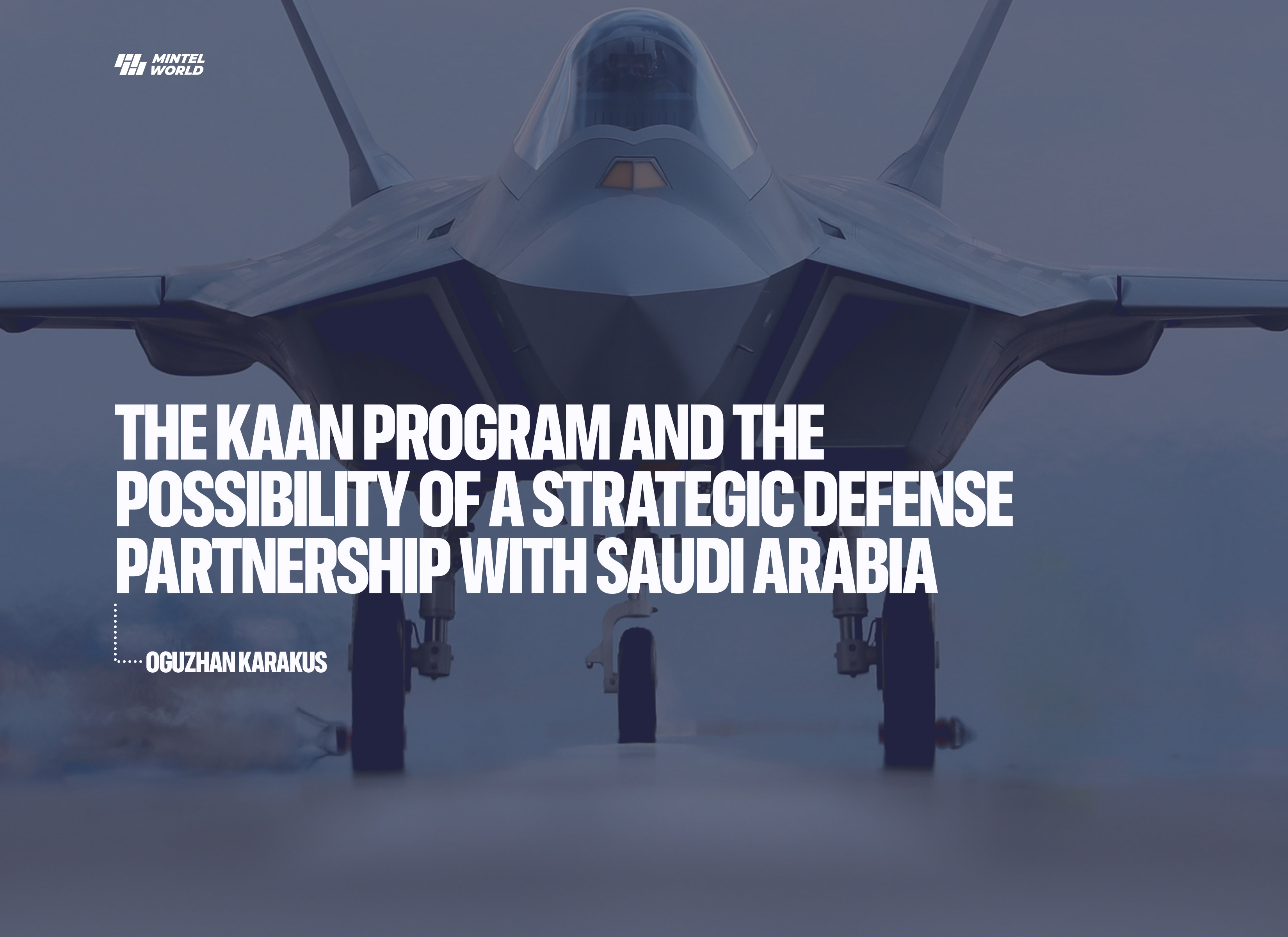
KAAN reflects a design philosophy centered on low detectability and survivability in high-threat environments. Its twin-engine configuration and airframe geometry are optimized for a reduced radar cross section. The aircraft’s mission architecture extends beyond air-to-air combat to include deep strike, electronic warfare, and network-centric operations. KAAN is therefore framed less as a conventional fighter and more as a multi-layered air-combat system.
This architecture raises important integration questions regarding interoperability with the Royal Saudi Air Force’s existing F-15SA and Eurofighter Typhoon fleets. NATO-compatible data links, mission-planning software, and command-and-control integration would form the technical backbone of KAAN’s incorporation into the Saudi inventory. This represents a key advantage over Chinese or Russian alternatives. Interoperability is not only operationally decisive, but also politically and strategically essential for long-term continuity.
Two principal bottlenecks confront the program: financial sustainability and engine technology. Fifth-generation projects frequently exceed initial budget projections. Extended testing phases, continuous software updates, and complex certification processes intensify cost pressures. Engine development is particularly critical. Thrust-to-weight ratio, supercruise capability, and thermal signature management elevate the engine from a subsystem to a strategic determinant of overall aircraft performance.
Production scale directly shapes the program’s trajectory. Limited production volumes keep unit costs high and extend the amortization period of industrial infrastructure. By contrast, surpassing a defined production threshold reduces per-unit costs, stabilizes supply chains, preserves workforce continuity, and allows production lines to operate efficiently. For this reason, feasibility studies appear to assess scenarios that go beyond minimal procurement assumptions toward larger-scale production models.
Saudi Arabia’s annual defense budget of approximately USD 70 billion, combined with its capacity to finance R&D and production through large-scale investment mechanisms, represents a critical variable in this equation. Riyadh’s inclusion as a financial partner could accelerate R&D timelines while reducing uncertainty surrounding production scale. Parallel engine development efforts in Turkey, when combined with international partnership options, could further distribute technological risk. In this context, Saudi capital would represent not merely funding, but a long-term commitment to defined production volumes.
KAAN’s current stage underscores the rationale for international partnership. Engine sourcing, export restrictions on avionics subsystems, and financing continuity increasingly challenge single-country management. Saudi participation would not eliminate these constraints, but it could enhance scalability and make industrial planning more predictable.
Strategic and Economic Gains for Both Countries
From Turkey’s perspective, Saudi involvement primarily means shared financial risk. However, the benefits extend beyond budgetary relief. Expanded production scale would reduce unit costs and improve the sustainability of procurement for the Turkish Air Force. Reaching higher volume thresholds would also enable more efficient operation of final assembly lines and greater capacity utilization across domestic industry.
Analyses by Turkish Aerospace Industries distinguish clearly between a limited export sale and a deeper industrial partnership. A small-batch procurement may deliver short-term export success, but it does not transform the production ecosystem. By contrast, higher-volume models based on shared production processes generate more meaningful gains in cost efficiency and strategic interdependence. This suggests that Turkey positions KAAN not simply as a platform, but as an industrial and technological project.
This marks a qualitative shift in Turkey’s defense-industrial posture. The objective is no longer limited to exporting systems, but to co-develop complex platforms, offer structured technology transfer, and manage multinational production networks. In doing so, Turkey seeks to move beyond the role of a traditional buyer or mid-tier supplier toward becoming a rule-setting participant in selected segments of the global defense market.
For Saudi Arabia, the gains are more structural and long-term. Participation in KAAN would provide not only access to an advanced air platform, but also opportunities for know-how transfer and human-capital development. Involvement of Saudi engineers in design, testing, and production would create a learning environment aligned with Vision 2030’s localization objectives. While immediate operational benefits may be limited, the medium- and long-term implications for strategic autonomy are significant.
At the joint level, the prospect of building a partially non-Western defense ecosystem in the Middle East becomes salient. Such an ecosystem would extend beyond platform production to include software development, maintenance, training, and modernization. Over time, this structure could offer an alternative reference point for third countries and establish a new center of gravity in the regional defense market.
Category | Specification / Feature | Notes |
Generation | Fifth Generation (5th Gen) | Low observability, sensor fusion, network-centric architecture |
Manufacturer | Turkish Aerospace (TA) | Prime contractor and system integrator |
Configuration | Twin-engine | Designed for higher survivability and payload flexibility |
Role | Multi-role air superiority fighter | Air-to-air, deep strike, electronic warfare |
Stealth Features | Reduced Radar Cross Section (RCS) | Internal weapons bays, optimized airframe geometry |
Combat Radius (Projected) | ~600+ nautical miles (est.) | Dependent on mission profile |
Maximum Speed (Projected) | Mach 1.8+ | Supersonic performance |
Supercruise Capability | Planned | Subject to final engine configuration |
Engine (Initial Blocks) | F110-GE-129 (interim) | U.S.-origin engine for early production batches |
Indigenous Engine (Planned) | TRMotor / Turkish national engine program | Long-term goal for full autonomy |
Avionics Architecture | Fully digital, modular | Software-defined capabilities |
Radar System | AESA Radar (domestic development) | Active electronically scanned array |
Sensor Fusion | Advanced multi-sensor integration | 360° situational awareness |
Data Link | NATO-compatible | Interoperable with allied C2 systems |
Cockpit | Large Area Display (LAD) | Glass cockpit, advanced HMI |
Electronic Warfare Suite | Integrated EW system | Defensive & offensive electronic capabilities |
Weapons Configuration | Internal + External hardpoints | Internal bays for stealth missions |
First Flight | 2024 (prototype) | Ongoing flight test campaign |
Projected IOC | Early 2030s | Subject to development timeline |
Mission Concept | Network-Centric Warfare Platform | Designed as part of a “system of systems” architecture |
Saudi Arabia’s Strategic Dilemma and KAAN in the Context of Vision 2030
A central challenge in Saudi defense procurement is vulnerability arising from reliance on single-source suppliers. Uncertainty surrounding potential access to the F-35 program has highlighted this exposure. Conditioning access to critical platforms on political considerations introduces unpredictability into long-term force planning. This experience has reinforced the need for diversification.
Saudi interest in KAAN reflects a calculated response to the limitations of a procurement model heavily centered on U.S. suppliers. Riyadh continues to depend on American systems for near-term operational effectiveness. However, growing political conditionality and uncertainty surrounding future transfers have underscored structural vulnerabilities.
Diversification is not pursued as a rupture with existing partners, but as a means of restoring bargaining space within a politicized procurement environment. The cost of waiting and the risks of delayed capability also factor into this calculus. KAAN represents a long-term hedge rather than an immediate substitute.
Even with access to advanced U.S. platforms, Saudi Arabia remains dependent on American upgrade cycles, software baselines, weapons-integration approvals, and sustainment pipelines. Participation in KAAN would offer earlier-stage influence over platform development, including potential roles in production, maintenance, and software domains that are largely inaccessible in U.S.-controlled programs. In this sense, KAAN expands Saudi strategic agency rather than compensating for denied access.
The parallel pursuit of U.S. systems and KAAN illustrates a deliberate division of labor: U.S. platforms provide immediate deterrence within an established operational ecosystem, while KAAN functions as a long-term hedge designed to dilute technological and political single-point dependence.
Vision 2030 institutions translate this objective into concrete industrial targets. The goal is not merely assembly capacity, but competence in high-value domains such as software, systems integration, and lifecycle management. If KAAN were to provide meaningful access to sovereign software layers or greater code-level influence, it would align strongly with these objectives. As fifth-generation aircraft evolve into networked “systems of systems,” data security and cyber resilience become central to military effectiveness.
Saudi Arabia’s preference for a NATO-compatible platform over Chinese or Russian alternatives reflects this logic. Interoperability with existing command-and-control structures and coalition partners remains indispensable.
Risks and the Positions of Global Actors
Countries such as the United States and the United Kingdom, as suppliers of critical aviation subsystems, are likely to assess KAAN’s international dimension through export-control regimes. U.S. ITAR regulations and related frameworks may constrain technology sharing in avionics, engine subsystems, mission computers, and software architectures.
Recent reporting suggests that prospective KAAN–Saudi cooperation has generated unease in U.S. policy circles. Concerns are linked not only to alliance management, but also to potential implications for U.S. defense export volumes to Saudi Arabia. For decades, Washington has maintained strategic leverage through sustained arms sales that anchor Saudi force planning within U.S.-centric ecosystems. From this perspective, significant Saudi financial commitment to KAAN could reduce future budgetary space for U.S. acquisitions and upgrades.
Even absent formal prohibitions, heightened scrutiny, conditional licensing, or procedural delays could serve as political signals. In the short term, such constraints might generate cost increases or schedule slippage.
Over the longer term, however, external pressure could accelerate Turkey’s drive toward greater subsystem indigenization. Past localization dynamics suggest that export constraints can deepen technological foundations. This transformation, however, requires time, capital, and advanced engineering capacity.
Regional Power Balance
Geopolitically, a KAAN–Saudi partnership would resonate primarily along the Iran–Israel axis. Iran’s air-defense modernization and missile capabilities shape Saudi threat perceptions in the Gulf. Riyadh therefore views long-term enhancement of airpower as a strategic priority.
Israel’s defense doctrine centers on maintaining a Qualitative Military Edge (QME). Any advanced fighter program in the region would be closely monitored. However, the introduction of KAAN into Saudi service would be perceived less as an immediate operational disruption and more as a gradual structural development. Israel’s integration with U.S. intelligence, sensor fusion, and network-centric warfare systems continues to underpin its QME.
Accordingly, regional effects would likely manifest as incremental adjustments rather than abrupt power shifts.
Project Timeline Risk
A key vulnerability in the KAAN program is the potential mismatch between development timelines and Saudi Arabia’s near-term security requirements. Full operational capability in the early 2030s may not align with more immediate threat perceptions. The cost of waiting therefore becomes a central consideration.
Temporal risk extends beyond technical development. Engine maturation, mission-software certification, weapons integration, and sustainment infrastructure will determine real operational value. Multinational decision-making and industrial coordination can further complicate timelines.
For this reason, any KAAN–Saudi partnership should be understood as a long-term, multidimensional strategic undertaking rather than a narrow procurement transaction.
Conclusion
A Turkey–Saudi Arabia partnership centered on KAAN carries the potential to transform both countries’ roles in the defense industry. The significance lies not merely in acquiring a next-generation platform, but in advancing toward joint development, risk-sharing, and technology production.
Over time, KAAN could anchor a structural and institutional security architecture between Ankara and Riyadh that extends beyond episodic political rapprochement. In such a framework, KAAN would represent not only a fighter aircraft, but a concrete expression of a more diversified and strategically autonomous defense paradigm.
Relevant sources:
· The Cost of Developing Advanced Tactical Aircraft, RAND Corporation, date accessed February 15, 2026,
https://www.rand.org/pubs/research_reports/RR275.html
· F-35 Joint Strike Fighter (JSF) Program, Congressional Research Service, date accessed February 15, 2026,
https://crsreports.congress.gov/product/pdf/R/R46265
· Why Only a Few Nations Can Build Fifth-Generation Fighters, Air & Space Forces Magazine, date accessed February 15, 2026,
https://www.airandspaceforces.com/article/fifth-generation-fighter-development/
· Arms Production, Technology Transfer and Collaborative Programs, SIPRI, date accessed February 15, 2026,
https://www.sipri.org/publications/arms-production
· Defence-Industrial Cooperation and Strategic Autonomy, IISS Survival: Global Politics and Strategy, April–May 2020, date accessed February 15, 2026,
https://www.iiss.org/publications/survival/2020/survival-global-politics-and-strategy-april-may-2020
· Collaborative Defence R&D and Innovation Models, OECD, date accessed February 15, 2026,
https://www.oecd.org/sti/defence-innovation/
· International Traffic in Arms Regulations (ITAR) Overview, U.S. Department of State, date accessed February 16, 2026,
https://www.pmddtc.state.gov/ddtc_public/ddtc_public?id=ddtc_public_portal_itar_landing
· Export Controls and the Defense Industrial Base, Center for Strategic and International Studies (CSIS), date accessed February 16, 2026,
https://www.csis.org/analysis/export-controls-and-defense-industrial-base
· The Limits of Technology Transfer in Combat Aircraft Programs, Royal United Services Institute (RUSI), date accessed February 16, 2026,
https://rusi.org/explore-our-research/publications/whitehall-reports
· Saudi Vision 2030: Defense and Localization Strategy, Vision 2030 Official Portal, date accessed February 16, 2026,
https://www.vision2030.gov.sa
· General Authority for Military Industries (GAMI) – Institutional Framework, GAMI, date accessed February 16, 2026,
https://gami.gov.sa
· Saudi Arabian Military Industries (SAMI) – Corporate Strategy, SAMI, date accessed February 16, 2026,
https://www.sami.com.sa
· Saudi Arabia’s Defense Industrialization Drive, Chatham House, date accessed February 16, 2026,
https://www.chathamhouse.org/2021/saudi-arabias-defense-industrialization
· Turkish Aerospace in Final Stages of Talks Over Saudi Role in KAAN Fighter Program, Breaking Defense, date accessed February 16, 2026,
https://breakingdefense.com/2026/02/exec-turkish-aerospace-in-final-stages-of-talks-over-saudis-in-kaan-fighter-program/
· Turkey Courts Saudi Arabia Over KAAN Stealth Fighter Deal but Faces Hurdles, Al-Monitor, date accessed February 16, 2026,
https://www.al-monitor.com/originals/2026/02/turkey-courts-saudi-arabia-kaan-stealth-fighter-deal-faces-hurdles
· KAAN at a Crossroads: Saudi Arabia to Choose Between Buying 20 Jets or Building Them, Türkiye Today, date accessed February 16, 2026,
https://www.turkiyetoday.com/nation/kaans-crossroads-saudi-arabia-to-choose-between-buying-20-jets-or-building-them-3214491
· Erdoğan Pitches KAAN Fighter Jet as Alternative to Western Warplanes, Defense News, date accessed February 16, 2026,
https://www.defensenews.com/global/mideast-africa/2026/02/10/erdogan-pitches-kaan-fighter-jet-as-an-alternative-to-western-warplanes/
· Emirati and Saudi Ambitions for Next-Generation Fighter Aircraft, Arab Gulf States Institute in Washington (AGSIW), date accessed February 16, 2026,
https://agsi.org/analysis/emirati-and-saudi-ambitions-for-next-generation-fighters/
· Saudi Arabia Reportedly Eyeing TAI KAAN Fighter Jet, The Aviationist, date accessed February 15, 2026,
https://theaviationist.com/2025/01/06/saudi-arabia-reportedly-eyeing-tai-kaan/
· Saudi Arabia’s Turkey KAAN jet talks irk Trump administration bent on arms export dominance, Middle East Eye, date accessed February 17, 2026,
https://www.middleeasteye.net/news/saudi-arabias-turkeys-kaan-jet-talks-irk-trump-administration-bent-arms-export-dominance
Related Intelligence


Daily Brief
Get the daily intelligence summary delivered to your inbox every morning.