


Military Diplomacy at the Muscat Threshold: The Direction of Iran–U.S. Talks
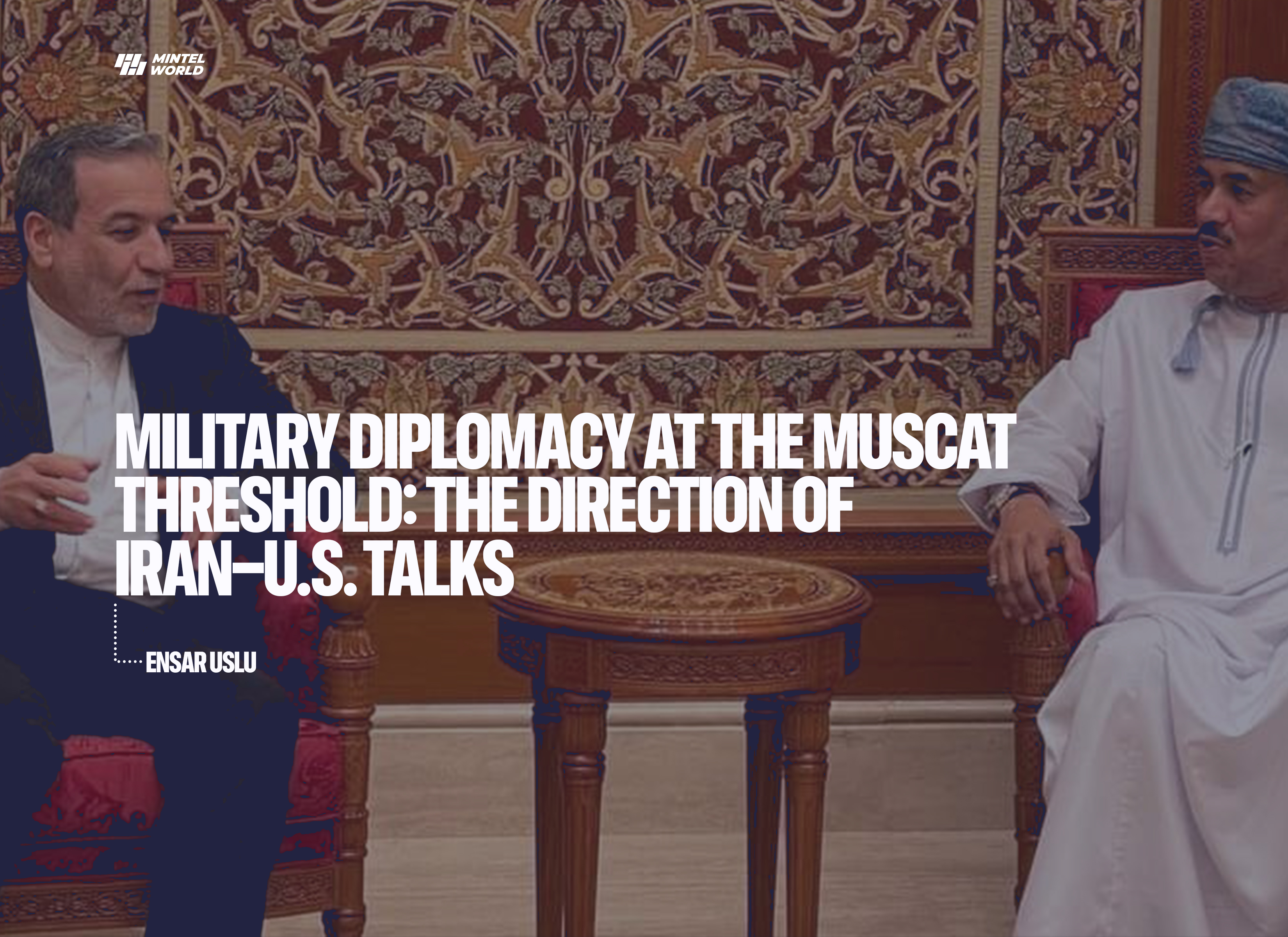
The Iran–U.S. talks that began in Muscat in February 2026 represent less a conventional diplomatic opening than an exercise in crisis management. Although the parties have returned to the negotiating table, military pressure has not disappeared. On the contrary, diplomacy and deterrence are being conducted simultaneously. For this reason, the process should be viewed not as peacebuilding, but as an attempt to prevent a new war.
Within this equation, Israel’s position has hardened markedly. Following the 2025 war, Tel Aviv is no longer seeking only the limitation of Iran’s nuclear capacity. It is also demanding restrictions on Iran’s ballistic missile program, its unmanned aerial vehicle capabilities, and the further weakening of regional proxy networks that were already strained in the aftermath of October 7 and the subsequent political shifts in Syria. From Israel’s perspective, the issue is no longer merely the nuclear threshold; it is the totality of Iran’s military capacity and regional power.
For this reason, Israel wants any potential agreement to affect not only uranium enrichment levels but also Iran’s broader deterrence architecture. Limiting the nuclear program alone is considered insufficient; neutralizing Iran’s military infrastructure and regional influence has emerged as the strategic objective. This approach further complicates the debate over scope within the Muscat talks.
In the short term, the likelihood of a comprehensive and final agreement appears weak. A more probable scenario involves narrow and incremental arrangements designed to keep tensions under control. However, a harder possibility also exists. The United States, with Israel’s support, may deliberately toughen the process by presenting Iran with demands that are difficult to accept and by using a diplomatic impasse in favor of military pressure. Such an approach could include limited but heavy airstrikes targeting not only nuclear infrastructure but also the power centers of the Iranian regime.
Yet even sustained air operations would be unlikely to completely dismantle the regime. The political structure of the Iranian Revolution, its security doctrine, and its layered ideological organization are deep and multi-dimensional. In this context, the objective of a potential strike would likely be not regime overthrow, but rather the weakening or restructuring of both the political and military command architecture.
The Pattern of Iran–U.S. Negotiations (1979–2024)
The dominant model shaping relations between Iran and the United States since 1979 has been based less on comprehensive political reconciliation and more on crisis management and limited technical bargaining. The resolution of the hostage crisis and the legal and technical mechanisms developed thereafter did not produce strategic normalization between the two countries. Instead, they created narrow communication channels through which high-cost ruptures could be contained. This structure persisted in the decades that followed. Indirect mediation was preferred over direct diplomatic contact, cycles of sanctions and countermeasures became entrenched, and communication advanced within a security-centered framework.
In the 2000s, the centralization of the nuclear file defined the boundaries of negotiation. Temporary compromises became possible in technically verifiable areas. However, no durable common ground emerged on issues such as regime security, regional power projection, and ballistic missile capacity. Over time, the nuclear file ceased to be merely a problem-solving domain and became the central axis of broader strategic competition.
The JCPOA represented a significant balancing attempt in this context. Its model envisioned sanctions relief in exchange for verification and limitation. Anchored in the international framework through United Nations Security Council Resolution 2231, the arrangement sought to partially separate technical compliance from political mistrust. However, the rupture after 2018 eliminated this separation. The nuclear file once again became a direct component of strategic rivalry.
The revival efforts between 2021 and 2024 failed for similar reasons. The parties retained the capacity to produce technical texts. Nevertheless, mutual confidence in the sustainability of implementation could not be established. Negotiations did not evolve into a transformative framework. The process remained an instrument for temporarily limiting the costs of crisis.
The Shift of Talks from Turkey to Oman
Prior to the Muscat talks, Turkey, Saudi Arabia, and Egypt had attempted to pursue a more coordinated regional diplomacy. These three countries emphasized that tensions between Iran and the United States did not concern only the two states, and that any potential war would directly affect the entire Middle East.
For this reason, they sought to establish a broader consultation platform. The aim was for regional countries to conduct a joint assessment and attempt to prevent military escalation through a shared political stance. In this way, crisis management would not be left solely to the decisions of Washington, Tel Aviv, and Tehran; regional actors could exert more direct and balanced influence on the process.
This approach offers a rational framework, particularly in terms of energy security, maritime stability, and the control of proxy conflict zones. Turkey’s NATO membership and diplomatic capacity, Saudi Arabia’s weight in the Gulf, and Egypt’s central position in the Arab world make such a multilateral initiative strategically meaningful. This model holds the potential to connect negotiations not only to the nuclear technical file but also to the broader regional security architecture.
However, Iran did not prefer such a format. Tehran wants the talks to remain strictly limited to the nuclear file. Discussing regional security, missile capacity, or proxy networks in a multilateral setting would expand the bargaining arena and increase pressure on Iran. For this reason, as in the past, Iran preferred Oman, which offers a more neutral and narrowly focused mediation model, rather than a NATO member state.
Oman has long been regarded as a reliable communication channel between Iran and the West. Its neutral stance, low-profile diplomatic tradition, and format that does not generate direct pressure provide a more controlled negotiation environment for Tehran. This preference aligns with Iran’s strategy of limiting the scope and narrowing negotiations to a technical framework.
Consequently, shifting the talks from a broader Turkey-centered regional framework to Oman is not merely a geographical change. It reflects a strategic choice regarding the scope of negotiations, the parties’ perception of risk, and the extent to which regional balance-of-power debates will be brought to the table.
The Structure of the Muscat Talks
The defining feature of the Muscat format is indirect negotiation. Rather than sitting at the same table, the parties communicate through a mediator. This method allows both sides to maintain hard rhetoric toward domestic audiences while creating technical flexibility behind closed doors. It reduces the political cost of direct contact while keeping communication channels open. Although the process may appear slow from the outside, it provides a functional structure for crisis management.
While keeping the diplomatic channel open, the United States continues to make elements of military pressure visible. This reflects the strategy of conducting negotiation and deterrence simultaneously. Iran, however, interprets this as negotiation under pressure and therefore insists that talks remain limited to the nuclear file. As a result, the parties operate within the same process but with different objectives and frameworks.
The core divergence at the table concerns scope. Washington believes that for nuclear limitations to be sufficient from a security standpoint, ballistic missile capacity and regional activities must also be discussed. Tehran views these issues as directly linked to regime security and perceives any expansion of scope as strategic pressure. Thus, the scope debate has evolved from a technical disagreement into a question of mutual intent and trust.
Israel’s Influence on the Talks
Israel’s security priorities directly shape the scope of the 2026 negotiation process. For Tel Aviv, the threat is not limited to uranium enrichment levels. Ballistic missile capacity, unmanned aerial systems, and the operational mobility of Iran’s regional proxy networks are evaluated within the same security framework. Therefore, Israel opposes an agreement that remains merely a technical nuclear package and demands a broader security arrangement.
Israel’s influence is evident in the United States’ tendency to expand scope. Washington, taking Israeli security concerns into account, seeks an agreement that produces not only nuclear limitations but also outcomes in terms of regional stability. Iran perceives this approach as a broader pressure strategy targeting regime security. Thus, the parties interpret the same text through different security perceptions.
Israel also occupies a central place in Iran’s deterrence calculus. Even if Tehran demonstrates limited flexibility on the nuclear file, it seeks to preserve balance vis-à-vis Israel by keeping missile capacity and regional influence outside the bargaining framework. This dynamic transform the agreement threshold from a technical issue into a strategic equilibrium problem. Without a shift in deterrence balances on the ground, achieving a comprehensive settlement appears difficult.
Category | Minimum (Pragmatic) Israeli Demand | Maximum (Structural) Israeli Demand | Strategic Logic Behind the Maximum Position |
Nuclear Program | Enrichment capped at low civilian levels (e.g., 3–5%); limits on advanced centrifuges; intrusive inspections | Dismantlement of advanced centrifuge cascades; removal of enriched stockpiles; long-term zero high-level enrichment | Eliminate Iran’s nuclear threshold capability permanently |
Breakout Time | Extend breakout time to at least 12 months | Structural elimination of breakout capacity altogether | Remove strategic ambiguity and pre-empt rapid nuclear escalation |
Ballistic Missiles | Freeze development of longer-range systems; cap testing frequency | Dismantlement or severe reduction of medium- and long-range missile arsenal | Neutralize direct strategic strike threat to Israel |
UAV Capabilities | Halt transfer of armed UAVs to proxies | Significant reduction of domestic UAV production infrastructure | Weaken asymmetric deterrence and regional force projection |
Regional Proxies | Limit arms transfers and financing to key actors (Lebanon, Syria) | Strategic rollback of Iran’s forward military presence across the region | Break the encirclement doctrine and restore conventional deterrence balance |
Command & Control Architecture | Transparency measures on military integration between IRGC units and regional actors | Degradation of integrated command networks linking missiles, UAVs, and proxies | Fragment Iran’s multi-domain deterrence system |
Sanctions & Enforcement | Automatic snapback clause in case of violation | Long-term sanctions architecture tied to regional behavior, not just nuclear compliance | Maintain leverage beyond the nuclear file |
Regional Security Architecture | Parallel regional dialogue mechanisms | Restructuring of Iran’s regional posture under international oversight | Redefine regional balance of power |
Scenarios
1- Limited-Scope Compromise (Positive)
In this scenario, the parties reach agreement on a limited and verifiable nuclear arrangement without resolving the scope debate. The focus would be on strengthening inspection access, reducing inventory ambiguities, and implementing phased and conditional sanctions relief in return. Both sides would signal to domestic audiences that their core positions remain intact. The indirect negotiation format would allow concessions to be framed not as political retreat but as technical adjustment.
The strongest aspect of this model is its ability to reduce escalation risk in the short term. Particularly during periods when maritime tensions become costly, a limited agreement could stabilize market expectations. If a credible verification framework is established, cycles of mutual accusation could slow and the crisis could be temporarily contained.
However, this approach does not resolve structural issues. Missile capacity and regional activities would remain deferred crisis domains. The persistence of snapback risks could limit economic relief, and the tangible benefits of the agreement could be questioned within Iran. Therefore, a limited compromise should be viewed not as a final solution, but as a temporary and manageable interim equilibrium.
In the Muscat context, this scenario would emerge not from deep trust, but from a shared assessment that the cost of conflict is too high for both sides. The agreement’s durability would depend not only on the text but also on sequencing, timing, and implementation. If managed carefully under a clear timetable, it could buy time and maintain low-level tension. If implementation weakens or ambiguity grows, short-term relief could give way to renewed deadlock.
2- Temporary Equilibrium Arrangement
In this scenario, the fundamental disagreement over scope remains unresolved. However, because the parties are unwilling to bear the cost of rupture, they do not terminate the process. Negotiations continue at low intensity. Limited field-level tension management is applied. Neither side offers major concessions; instead, they take temporary steps aimed at limiting the other’s cost-imposition capacity. Muscat, in this case, functions less as a production center for comprehensive agreement and more as a channel that sustains contact.
The principal advantage of this model is its relatively low domestic political cost. Iran emphasizes that it has not surrendered fundamental rights. The United States maintains that pressure instruments remain in place. This rhetorical balance may slow escalation in the short term while allowing both sides to test each other and gradually build limited confidence for future arrangements.
However, a temporary equilibrium does not solve structural issues. Uncertainties regarding stockpiles, enrichment levels, and inspection access persist. Most sanctions remain in force, and economic pressure does not fully ease. The possibility that Israel may deem the arrangement insufficient and take political or military steps to weaken it also remains. Thus, the resulting stability is fragile and easily disrupted by minor developments.
3- Regime-Targeted Intervention and Regional Shock (Negative)
In this scenario, the Muscat process fails to produce results and diplomacy loses functionality. The United States, potentially in coordination with Israel, concludes that negotiations will not yield outcomes and activates the military option. Targets extend beyond nuclear facilities. The command structure of the Islamic Revolutionary Guard Corps, the security architecture, and the political wing of the revolution could come under direct pressure. In its most severe version, Iran’s highest decision-making centers, including the Supreme Leader and his inner circle, could become direct targets.
The objective may not necessarily be total regime collapse. A more realistic goal could be weakening the existing power structure and opening space for a more pragmatic or moderate faction within the system. Given Iran’s ongoing economic crisis, high inflation, and recurring protests, it may be assumed that external pressure could alter internal power balances. In this framework, weakening leadership could aim to push the regime toward a more defensive and cautious posture.
However, direct targeting of the Supreme Leader and the core leadership would likely be perceived by Iran as an existential attack. Such a move could harden rather than fracture the regime. The Revolutionary Guard and security apparatus could respond more aggressively. Iran might pursue direct or indirect attacks against Israel and U.S. bases in the Gulf. Proxy fronts could expand, and the conflict could quickly take on a cross-border character.
The first and fastest effect of this scenario would be visible in energy markets. Any escalation signal related to the Strait of Hormuz would push oil prices upward. If the Strait were effectively closed or subjected to prolonged risk, oil prices exceeding $100 per barrel would be highly likely. Insurance costs would rise, shipments would slow, and global supply chains would come under pressure.
Sharp increases in oil prices would also reverberate in U.S. domestic politics. Through fuel prices and inflation, political pressure could intensify significantly. Rising energy costs directly influence voter behavior. At the same time, Asian economies — particularly China, India, Japan, and South Korea — which depend heavily on Hormuz flows, could respond strongly due to supply security concerns. These states might exert diplomatic pressure and attempt to influence the trajectory of events through global markets.
If regional military escalation deepens, even if the Iranian Revolution is not fully dismantled, control could weaken in certain areas. Internal security balances could be shaken and local conflicts could increase. This could trigger new and large migration flows toward Turkey and Iraq. Energy shock, regional security crisis, and humanitarian risk could emerge simultaneously.
For this reason, this scenario is not merely a military operation possibility. It represents a broad rupture risk directly affecting global energy balances, regional security, and major powers’ domestic political calculations. The loss of functionality of the Muscat channel would amplify this risk. Once a credible diplomatic framework collapses, even a limited military move could rapidly evolve into a larger and more costly conflict.
Conclusion
The Iran–U.S. talks that began in Muscat are not a normalization process, but an exercise in controlled crisis management. While keeping the diplomatic channel open, both sides continue to maintain military pressure instruments. This indicates that tensions are unlikely to fully subside in the short term, even as both parties consciously attempt to postpone direct war. The central fault line remains the scope issue. While a nuclear-only framework appears possible, missile capacity and regional activities continue to generate strategic blockage.
A limited compromise is possible, but it would not resolve structural issues. Conversely, if the diplomatic channel weakens, the military option cannot be entirely ruled out. Israel’s security approach and U.S. domestic political dynamics could harden the trajectory of the process.
Three critical fragility areas stand out: scope, the Israel factor, and energy security. Iran seeks to keep its security architecture outside the bargaining framework. If scope expands, negotiations could quickly stall. Israeli steps to weaken an agreement deemed insufficient could sabotage the process. The highest-cost domain remains energy. Any escalation related to the Strait of Hormuz would directly affect global prices and regional stability.
Strategically, the current period requires cautious positioning. Acting on the assumption that the process will completely collapse would be premature; however, failing to reduce risks under the expectation of a durable settlement would also be mistaken. Controlled tension in the short term and the possibility of abrupt rupture in the medium term must be evaluated simultaneously. Energy supply security, regional military movements, and sanctions regime scenarios should be monitored in parallel.
If the diplomatic channel loses functionality, military escalation would not remain confined to the Iran–U.S. axis. It would generate chain reactions across energy markets, regional security structures, and the global economic balance. For this reason, the Muscat process should be seen less as a peace opportunity and more as a mechanism for delaying a major rupture.
Related Sources
• U.S. Department of State, “Sanctions to Combat Illicit Traders of Iranian Oil and the Shadow Fleet” (February 2026) https://www.state.gov/releases/office-of-the-spokesperson/2026/02/sanctions-to-combat-illicit-traders-of-iranian-oil-and-the-shadow-fleet
• U.S. Congressional Research Service (CRS), “Iran and Nuclear Negotiations” (R47321) https://www.congress.gov/crs_external_products/R/PDF/R47321/R47321.9.pdf
• United Nations Security Council, Resolution 2231 (2015) https://undocs.org/S/RES/2231(2015)
• International Atomic Energy Agency (IAEA), “Verification and monitoring in the Islamic Republic of Iran in light of UNSCR 2231 (2015)” GOV/2025/24 https://www.iaea.org/sites/default/files/25/06/gov2025-24.pdf
• Institute for National Security Studies (INSS), Avishay Ben Sasson-Gordis et al., “Strategic Assessment: Scenarios for US Intervention in the Unrest in Iran and Possible Iranian Responses” No. 2086 (19.01.2026) https://www.inss.org.il/publication/strategic-assessment-us-intervention-iran-2026/
• International Institute for Strategic Studies (IISS), “Iran’s Missile Capabilities and Regional Deterrence Posture” (Strategic Dossier) https://www.iiss.org/research-paper/iran-missile-capabilities
• Carnegie Endowment for International Peace, “The Future of the Iran Nuclear Deal and Regional Security” https://carnegieendowment.org/research/2026/iran-nuclear-deal-regional-security
• Brookings Institution, “Iran’s Regional Strategy and the Limits of Deterrence”
https://www.brookings.edu/research/irans-regional-strategy-and-deterrence
• Atlantic Council, “The Next Phase of U.S.–Iran Nuclear Diplomacy”
• Chatham House, “Managing Escalation Between Iran and Israel”
https://www.chathamhouse.org/2026/iran-israel-escalation
• Center for Strategic and International Studies (CSIS), “Iran’s Military Doctrine and the Risk of Regional War” https://www.csis.org/analysis/irans-military-doctrine-and-regional-war-risk
• Washington Institute for Near East Policy, “Israel’s Red Lines in Iran Nuclear Negotiations” https://www.washingtoninstitute.org/policy-analysis/israels-red-lines-iran-negotiations
• European Council on Foreign Relations (ECFR), “Europe and the Iran Nuclear Crisis After JCPOA” https://ecfr.eu/publication/europe-and-the-iran-nuclear-crisis-2026/
• Middle East Institute (MEI), “Oman’s Mediation Role in U.S.–Iran Talks” https://www.mei.edu/publications/omans-mediation-role-us-iran-talks
• Stockholm International Peace Research Institute (SIPRI), “Missile Proliferation and Regional Stability in the Middle East” https://www.sipri.org/publications/2026/missile-proliferation-middle-east
• U.S. Energy Information Administration (EIA), “The Strait of Hormuz and Global Oil Flows” https://www.eia.gov/international/analysis/strait-of-hormuz.php
Related Intelligence

Daily Brief
Get the daily intelligence summary delivered to your inbox every morning.